By the Spark Fabrication shop · November 15, 2026
"5-axis" gets used for two different ways of cutting. Both run on the same machine, and both can save you money, but on different parts. Knowing which one your part needs makes the drawing better and the quote easier to compare.
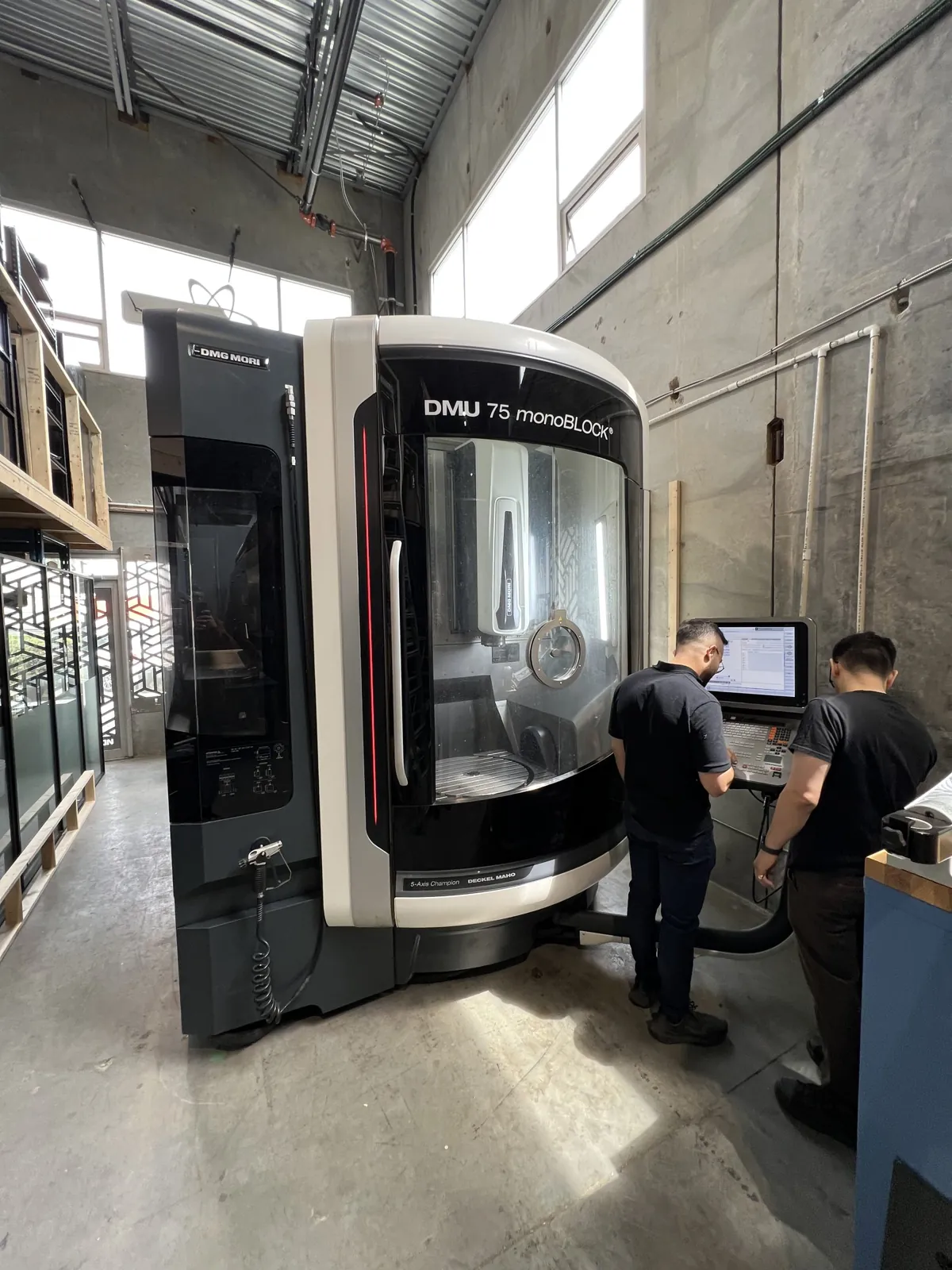
On our DMG MORI DMU 75, a round table (C) turns the part and a cradle (B) tilts it toward the spindle. With the three straight axes (X, Y, Z), that makes five.
3+2: tilt, lock, cut
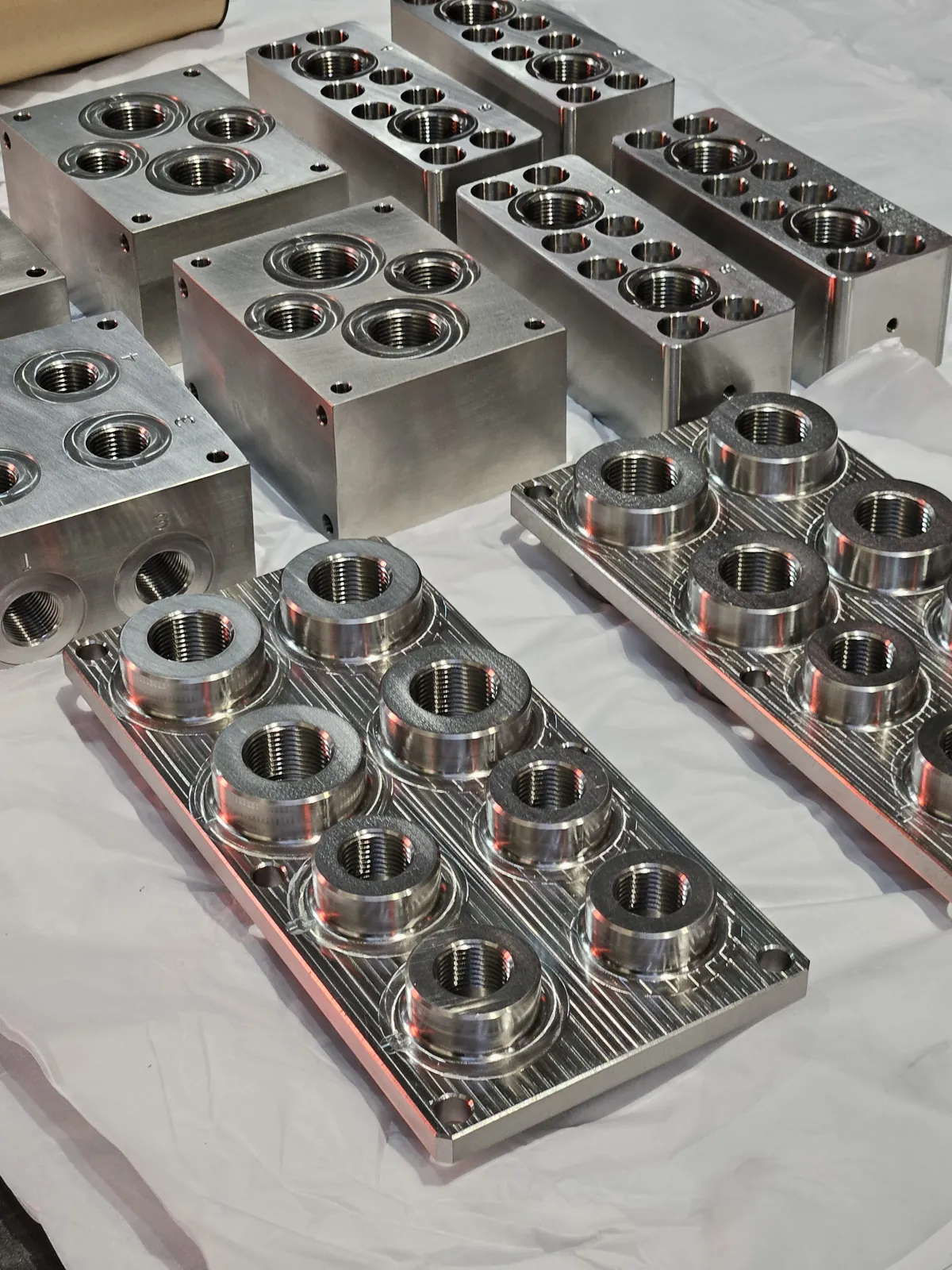
In 3+2 machining (also called positional 5-axis) the two rotary axes swing the part to an angle and stop. The machine then cuts like a normal 3-axis mill: straight moves in X, Y and Z. When that face is done, the part tilts to the next angle and the tool cuts again.
That's the right way to make:
- Holes and faces on several sides of a block, like manifolds, housings and brackets.
- Compound angles: a hole that has to be square to its own sloped face, not to the vise.
- Back chamfers, dovetails and features under an overhang.
- Deep pockets, where tilting the part lets a short, stiff tool reach the wall.
The tool is locked at a fixed angle for each cut, so the machine is as stiff as it can be. That gives a good finish and steady accuracy, and it is how most 5-axis parts are really made.
Full 5-axis: everything moves at once
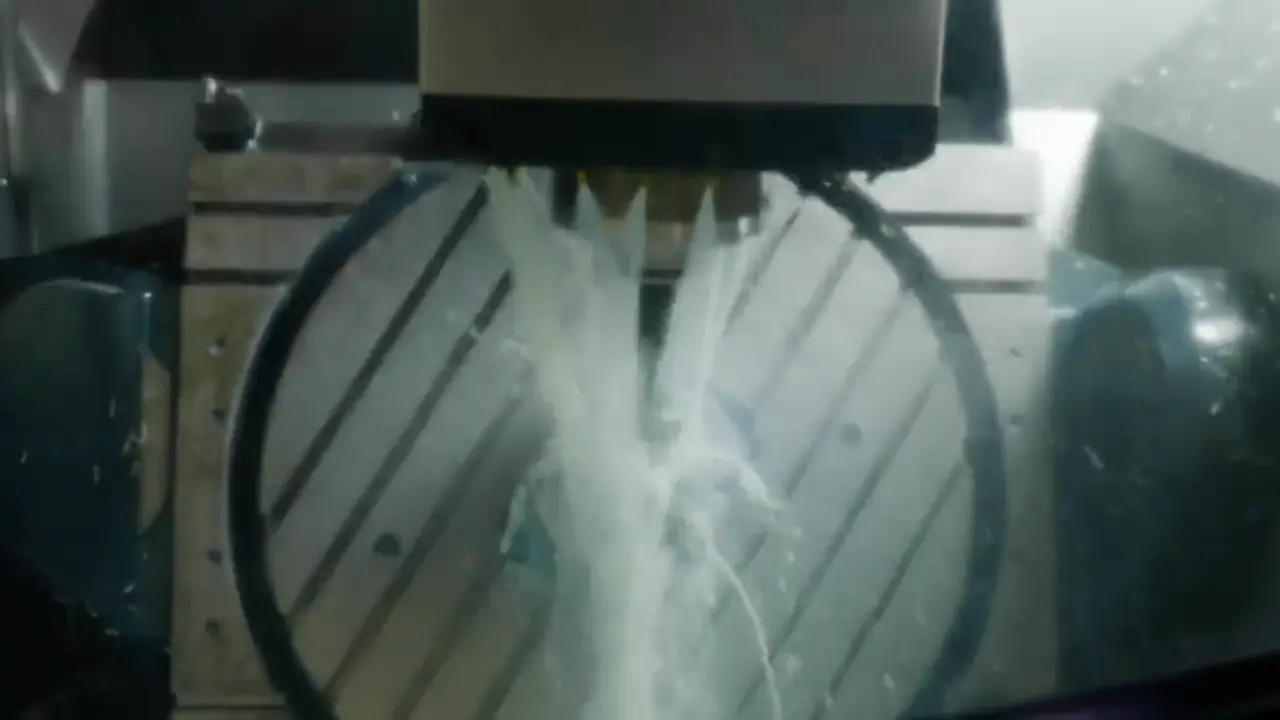
In simultaneous 5-axis, all five axes move together while the tool cuts. The tool stays tilted to the surface as it follows a curve, so it can sweep along a blade, round a port or across a sculpted face in one smooth pass.
You need it for:
- Impellers, blades and turbine-style shapes.
- Ports and channels that curve through a part.
- Molds, electrodes and freeform surfaces.
- Smooth blends where a 3-axis ball mill would leave visible steps.
Programming and checking those toolpaths takes longer, which adds to the price. If your part has no curved surface that needs the tool to follow it, you probably don't need it, and 3+2 will do the job.
Which kind of 5-axis does your part need?
3+2. Tilting the part to each side saves the re-clamps a 3-axis shop would need, and every feature is cut from the same zero.
A starting point only. Send the model and we'll tell you how we'd cut it.
Why one setup often costs less
On a 3-axis mill, a block with features on five sides is cut in five setups. Each one means stopping the machine, unclamping the part, flipping it, clamping it again and finding the zero again. That is labour you pay for, and often a fixture for each side.
There's a quality cost too. Every re-clamp adds a little error, and it stacks: a hole on the front only lines up with a hole on the back as well as the two setups agree. In one clamping, every feature is cut from the same zero, so they line up because they were never moved.
So the machine hour on a 5-axis costs more, but the part can still cost less: fewer setups, fewer fixtures, less handling and fewer parts lost to stack-up. That's especially true for one-offs and short runs, where setup time is a big share of the price.
When 5-axis isn't the answer
- Flat plates and simple pockets cut from one side. A 3-axis mill or our CNC router does these well.
- Round parts that are mostly turning. The DMU 75 can turn and mill in one clamping, but a lathe may be quicker for plain shafts.
- Large batches of a simple part, where a fixture holding several parts on a 3-axis machine can beat one part at a time.
We'll suggest the fastest way, even when it isn't the 5-axis.
Designing for 5-axis
- Put the datums on the drawing. Tell us which features must line up with which. That's what decides how the part is held and cut.
- Leave room to hold it. One setup still needs one clamp. A small tab or extra stock on the bottom, cut off later, often makes five faces reachable.
- Mark what's critical. ±0.005″ is our standard tolerance; tell us which features need tighter, so the rest isn't priced as if they all do.
- Send a 3D model. STEP or Parasolid, with a PDF drawing for tolerances and finish. Angled holes and curves are much easier to quote from a model.
Checking the result
Parts are measured against your drawing before they ship, and an inspection report is available on request. For larger parts and assemblies we also have a portable CMM that measures them where they stand.
Not sure which way your part should be cut? Send the model and the quantity. We'll tell you how we'd make it, and give you an estimate. Contact us for an exact quote.
Questions we hear
Is 5-axis machining more expensive than 3-axis?
Not always. The machine hour costs more, but a part with features on several sides often needs one setup instead of four or five, which saves fixtures, handling and zeroing. On those parts 5-axis is often the cheaper route; on a flat plate cut from one side, a 3-axis mill is.
What tolerances do you hold on the DMU 75?
±0.005″ as standard, tighter on suitable features. Tell us which features are critical and we'll confirm for your material and geometry.
How big a part fits on your 5-axis?
The DMU 75 table is 840 × 500 mm. Parts close to that size, or heavy ones, are worth a quick call so we can check the reach on all five sides.